Like Charges Attract
5A40.20 • D+10+25
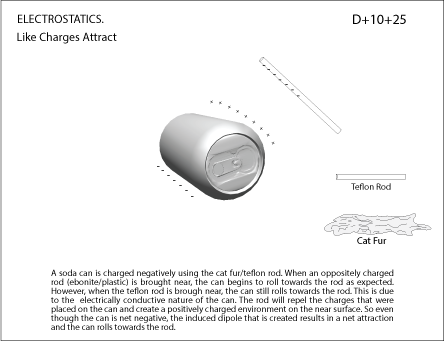
A soda can is charged negatively using the cat fur/teflon rod. When an oppositely charged rod (ebonite/plastic) is brought near, the can begins to roll towards the rod as expected. However, when the teflon rod is brought near, the can still rolls towards the rod. This is due to the electrically conductive nature of the can. The rod will repel the charges that were placed on the can and create a positively charged environment on the near surface. So even though the can is net negative, the induced dipole that is created results in a net attraction and the can rolls towards the rod.
Usage
Summer 2018 - Fall 2026
17
reservations across 2
classes
Related Demos
D+10+0 Electric fields: Lines of force shown on an OHP. D+10+2 Transparency: Mapping of an electric field. D+10+4 Pith balls on thread, with positive and negative charged rods. D+10+5 Vector arrows to show electric field and particle motion D+10+6 Attraction and repulsion of charged styrofoam balls. D+10+8 Braun and Leaf electroscopes. D+10+9 Discharging an electroscope through ionization D+10+10 Faraday's ice pail: Charge induced on the outside of a pail. D+10+11 Alternate charge resides on outside of conductor D+10+12 Charge resides on the outside of a conductor. D+10+13 Faraday cage: blocks signal from portable radio D+10+14 Charging an electroscope by induction. D+10+16 Separation of charge using electrical tape and an electroscope. D+10+18 Electrophorous: Cat fur on teflon, acetate on lucite. D+10+20 Van de Graaff generator. D+10+22 Wimshurst machine, large or small. D+10+24 Electrostatic pinwheel:Van de Graaff makes pinwheel spin. D+10+26 Various Leyden jars to show. D+10+28 Electrostatic doorbell: Ball bangs between charged plates. D+10+30 Kelvin water drop electrostatic charge generator. D+10+35 Electric field created by Van de Graff splits ions in flame