Kelvin water drop electrostatic charge generator.

5A40.70 • D+10+30
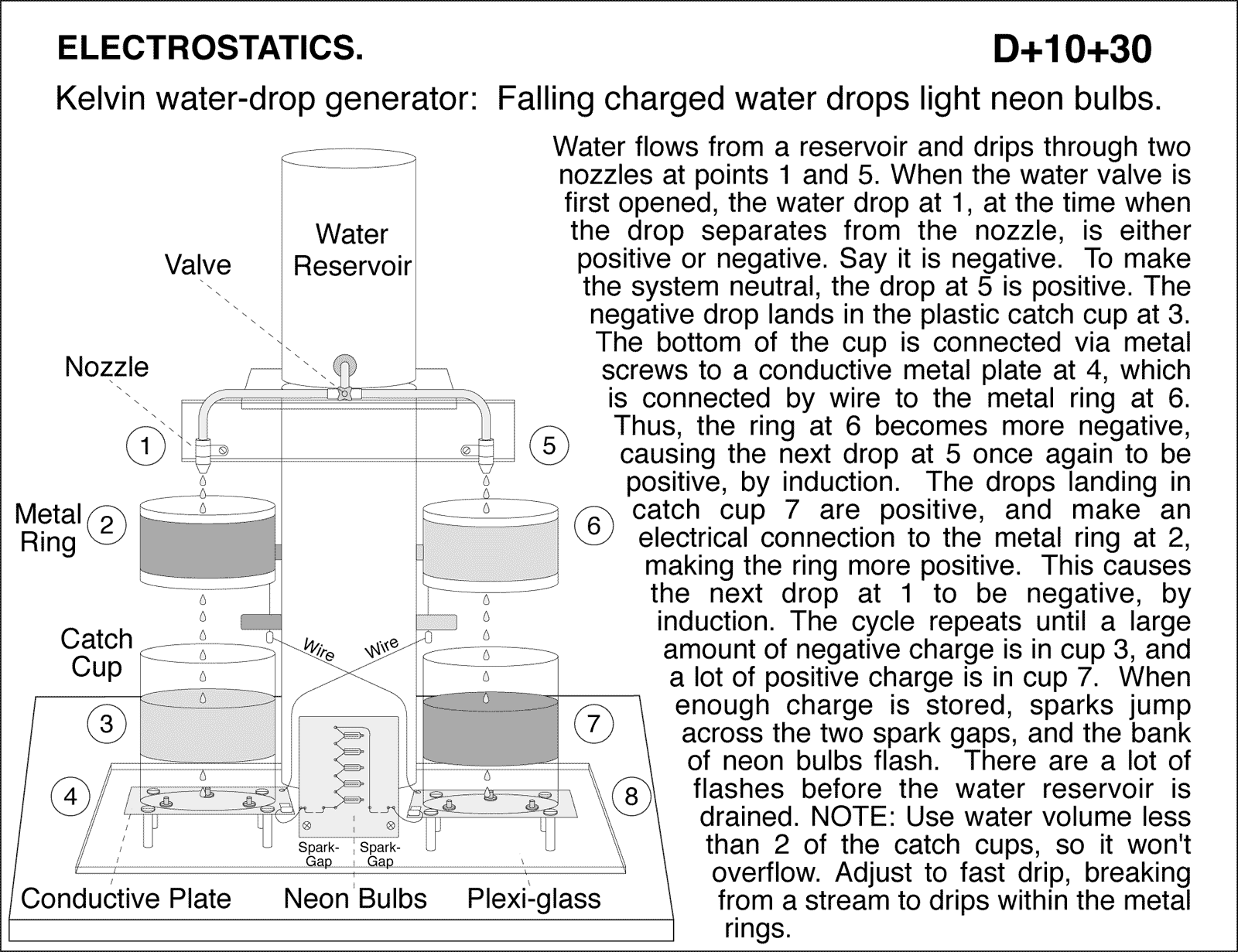
diagram for demo

Kelvin water-drop generator: Falling charged water drops light neon bulbs. Water flows from a reservoir and drips through two nozzles at points 1 and 5. When the water valve is first opened, the water drop at 1, at the time when the drop separates from the nozzle, is either positive or negative. Say it is negative. To make the system neutral, the drop at 5 is positive. The negative drop lands in the plastic catch cup at 3. The bottom of the cup is connected via metal screws to a conductive metal plate at 4, which is connected by wire to the metal ring at 6. Thus, the ring at 6 becomes more negative, causing the next drop at 5 once again to be positive, by induction. The drops landing in catch cup 7 are positive, and make an electrical connection to the metal ring at 2, making the ring more positive. This causes the next drop at 1 to be negative, by induction. The cycle repeats until a large amount of negative charge is in cup 3, and a lot of positive charge is in cup 7. When enough charge is stored, sparks jump across the two spark gaps, and the bank of neon bulbs flash. There are a lot of flashes before the water reservoir is drained. NOTE: Use water volume less than 2 of the catch cups, so it won't overflow. Adjust to fast drip, breaking from a stream to drips within the metal rings.

Related Demos


D+10+11 Alternate charge resides on outside of conductor D+10+25 Like Charges Attract D+10+45 Polarization of can causes rolling D+10+5 Vector arrows to show electric field and particle motion D+10+0 Electric fields: Lines of force shown on an OHP. D+10+2 Transparency: Mapping of an electric field. D+10+4 Pith balls on thread, with positive and negative charged rods. D+10+6 Attraction and repulsion of charged styrofoam balls. D+10+8 Braun and Leaf electroscopes. D+10+9 Discharging an electroscope through ionization D+10+10 Faraday's ice pail: Charge induced on the outside of a pail. D+10+12 Charge resides on the outside of a conductor. D+10+13 Faraday cage: blocks signal from portable radio D+10+14 Charging an electroscope by induction. D+10+16 Separation of charge using electrical tape and an electroscope. D+10+18 Electrophorous: Cat fur on teflon, acetate on lucite. D+10+20 Van de Graaff generator. D+10+22 Wimshurst machine, large or small. D+10+24 Electrostatic pinwheel:Van de Graaff makes pinwheel spin. D+10+26 Various Leyden jars to show. D+10+28 Electrostatic doorbell: Ball bangs between charged plates. D+10+35 Electric field created by Van de Graff splits ions in flame D+10+40 Applet: Charges and Fields D+10+45 Applet: Electric Field Hockey D+10+50 Applet: Electric Field of Dreams D+10+55 Applet: John Travoltage D+10+60 Applet: Balloons and Static Electricity D+10+65 Applet: 3D Electrostatic Field Simulation D+10+75 Applet: Field and potential produced by point charges D+10+80 Applet: Electrostatics Visualizations - The Charged Metal Slab D+10+85 Applet: Electric Field D+10+90 Electrostatics Index D+10+95 Applet: Electrostatics Simulation D+10+100 Applet: 2-D Electrostatic Field Simulation