Wimshurst machine, large or small.
5A50.10 • D+10+22
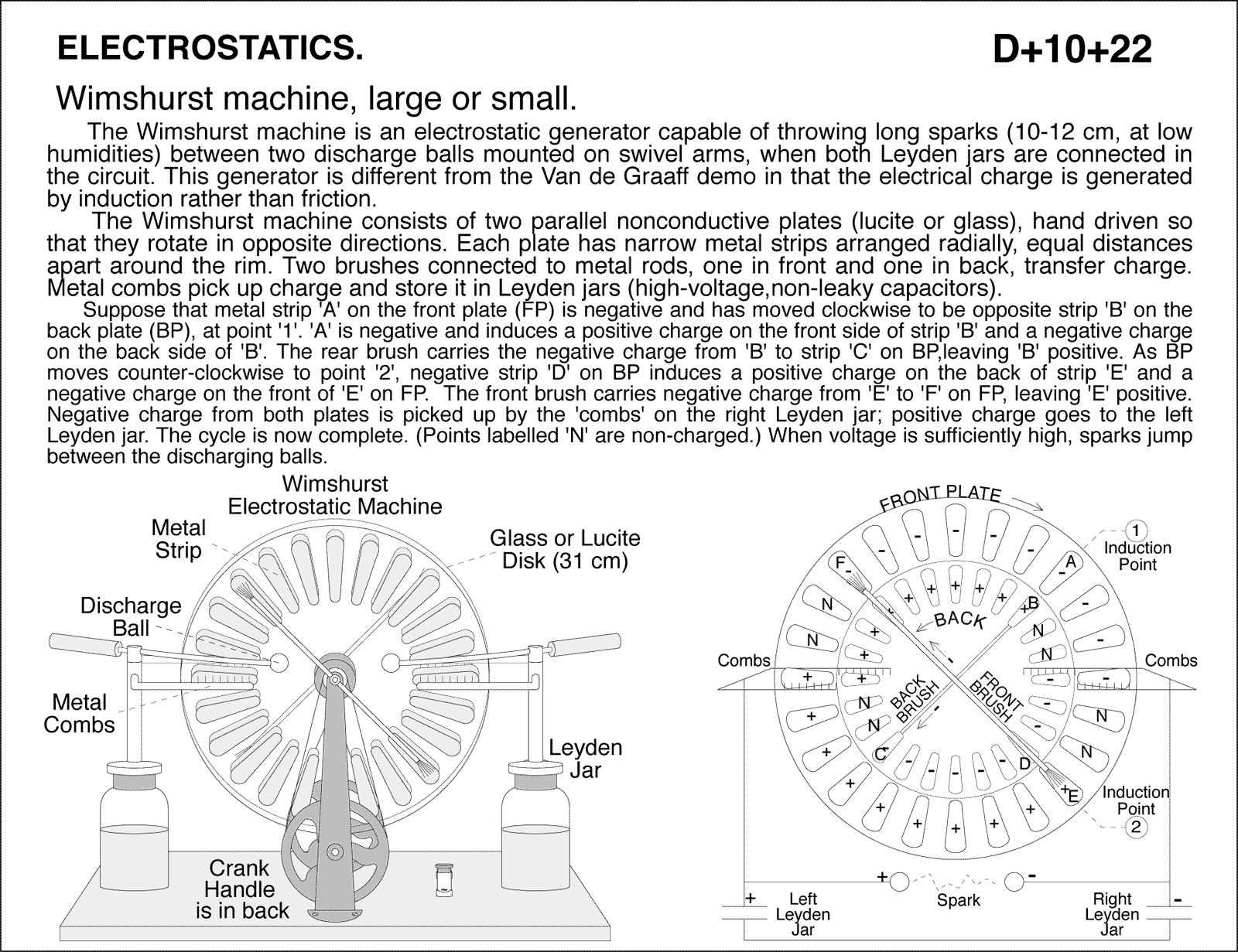
Wimshurst machine, large or small. The Wimshurst machine is an electrostatic generator capable of throwing long sparks (10-12 cm, at low humidities) between two discharge balls mounted on swivel arms, when both Leyden jars are connected in the circuit. This generator is different from the Van de Graaff demo in that the electrical charge is generated by induction rather than friction. The Wimshurst machine consists of two parallel nonconductive plates (lucite or glass), hand driven so that they rotate in opposite directions. Each plate has narrow metal strips arranged radially, equal distances apart around the rim. Two brushes connected to metal rods, one in front and one in back, transfer charge. Metal combs pick up charge and store it in Leyden jars (high-voltage,non-leaky capacitors). Suppose that metal strip 'A' on the front plate (FP) is negative and has moved clockwise to be opposite strip 'B' on the back plate (BP), at point '1'. 'A' is negative and induces a positive charge on the front side of strip 'B' and a negative charge on the back side of 'B'. The rear brush carries the negative charge from 'B' to strip 'C' on BP,leaving 'B' positive. As BP moves counter-clockwise to point '2', negative strip 'D' on BP induces a positive charge on the back of strip 'E' and a negative charge on the front of 'E' on FP. The front brush carries negative charge from 'E' to 'F' on FP, leaving 'E' positive. Negative charge from both plates is picked up by the 'combs' on the right Leyden jar; positive charge goes to the left Leyden jar. The cycle is now complete. (Points labelled 'N' are non-charged.) When voltage is sufficiently high, sparks jump between the discharging balls.
Summer 2013 - Summer 2025