Electrophorous: Cat fur on teflon, acetate on lucite.

5A10.20 • D+10+18
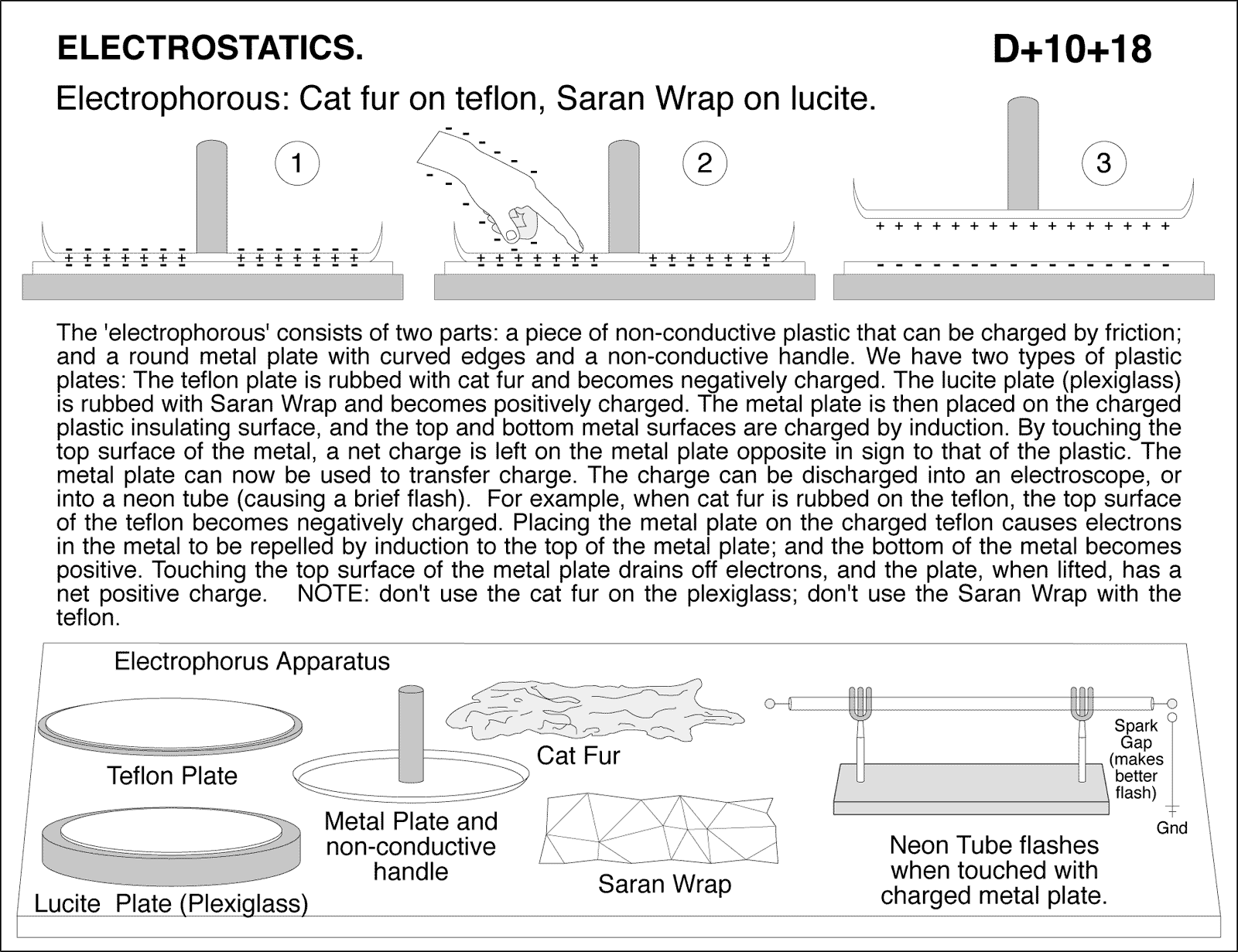
diagram for demo

Electrophorous: Cat fur on teflon, acetate on lucite. The 'electrophorous' consists of two parts: a piece of non-conductive plastic that can be charged by friction; and a round metal plate with curved edges and a non-conductive handle. We have two types of plastic plates: The teflon plate is rubbed with cat fur and becomes negatively charged. The lucite plate (plexiglass) is rubbed with Saran Wrap and becomes positively charged. The metal plate is then placed on the charged plastic insulating surface, and the top and bottom metal surfaces are charged by induction. By touching the top surface of the metal, a net charge is left on the metal plate opposite in sign to that of the plastic. The metal plate can now be used to transfer charge. The charge can be discharged into an electroscope, or into a neon tube (causing a brief flash). For example, when cat fur is rubbed on the teflon, the top surface of the teflon becomes negatively charged. Placing the metal plate on the charged teflon causes electrons in the metal to be repelled by induction to the top of the metal plate; and the bottom of the metal becomes positive. Touching the top surface of the metal plate drains off electrons, and the plate, when lifted, has a net positive charge. NOTE: don't use the cat fur on the plexiglass; don't use the Saran Wrap with the teflon

Related Demos


D+10+11 Alternate charge resides on outside of conductor D+10+25 Like Charges Attract D+10+45 Polarization of can causes rolling D+10+5 Vector arrows to show electric field and particle motion D+10+0 Electric fields: Lines of force shown on an OHP. D+10+2 Transparency: Mapping of an electric field. D+10+4 Pith balls on thread, with positive and negative charged rods. D+10+6 Attraction and repulsion of charged styrofoam balls. D+10+8 Braun and Leaf electroscopes. D+10+9 Discharging an electroscope through ionization D+10+10 Faraday's ice pail: Charge induced on the outside of a pail. D+10+12 Charge resides on the outside of a conductor. D+10+13 Faraday cage: blocks signal from portable radio D+10+14 Charging an electroscope by induction. D+10+16 Separation of charge using electrical tape and an electroscope. D+10+20 Van de Graaff generator. D+10+22 Wimshurst machine, large or small. D+10+24 Electrostatic pinwheel:Van de Graaff makes pinwheel spin. D+10+26 Various Leyden jars to show. D+10+28 Electrostatic doorbell: Ball bangs between charged plates. D+10+30 Kelvin water drop electrostatic charge generator. D+10+35 Electric field created by Van de Graff splits ions in flame D+10+40 Applet: Charges and Fields D+10+45 Applet: Electric Field Hockey D+10+50 Applet: Electric Field of Dreams D+10+55 Applet: John Travoltage D+10+60 Applet: Balloons and Static Electricity D+10+65 Applet: 3D Electrostatic Field Simulation D+10+75 Applet: Field and potential produced by point charges D+10+80 Applet: Electrostatics Visualizations - The Charged Metal Slab D+10+85 Applet: Electric Field D+10+90 Electrostatics Index D+10+95 Applet: Electrostatics Simulation D+10+100 Applet: 2-D Electrostatic Field Simulation