Visible nodes and antinodes in linearly birefringent plexiglass rod.

6H35.17 • E+45+110
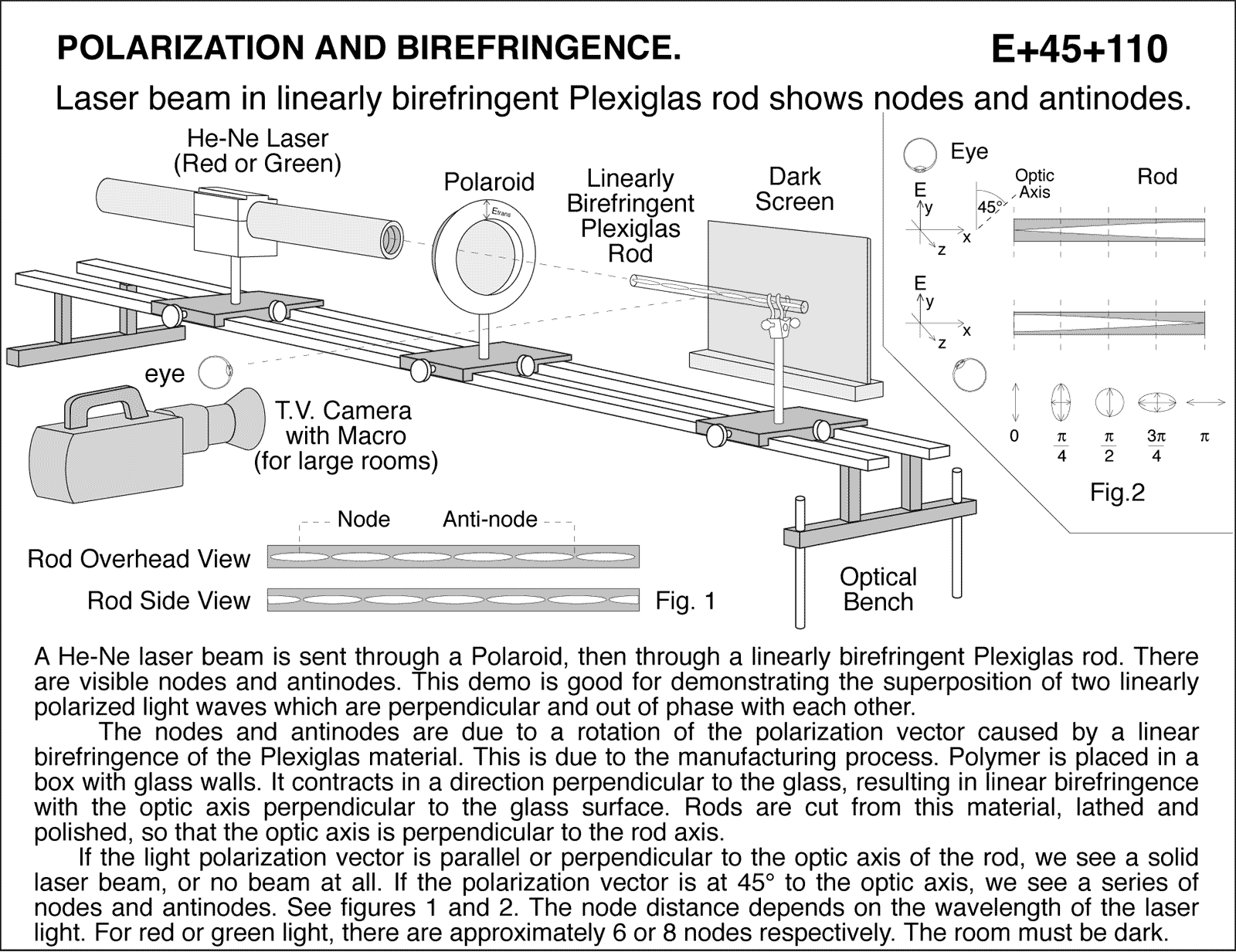
diagram for demo

Laser beam in linearly birefringent Plexiglas rod shows nodes and antinodes. A He-Ne laser beam is sent through a Polaroid, then through a linearly birefringent Plexiglas rod. There are visible nodes and antinodes. This demo is good for demonstrating the superposition of two linearly polarized light waves which are perpendicular and out of phase with each other. The nodes and antinodes are due to a rotation of the polarization vector caused by a linear birefringence of the Plexiglas material. This is due to the manufacturing process. Polymer is placed in a box with glass walls. It contracts in a direction perpendicular to the glass, resulting in linear birefringence with the optic axis perpendicular to the glass surface. Rods are cut from this material, lathed and polished, so that the optic axis is perpendicular to the rod axis. If the light polarization vector is parallel or perpendicular to the optic axis of the rod, we see a solid laser beam, or no beam at all. If the polarization vector is at 45 deg to the optic axis, we see a series of nodes and antinodes. See figures 1 and 2. The node distance depends on the wavelength of the laser light. For red or green light, there are approximately 6 or 8 nodes respectively. The room must be dark.

Related Demos


E+45+61 Shiny object turns black viewed through linear polarizer and quarter wave plate E+45+0 Two picket fence sections with slats and rope to make waves. E+45+5 Microwaves with grid. Transmitter and receiver are polarized. E+45+10 Malus experiment: Polarization by reflection off glass surface. E+45+15 Polarization of light by internal reflection: Fresnel rhomb. E+45+20 Polarization of light through a pile of glass plates, using arc lamp. E+45+25 Commercial Polaroid filters on an OHP. E+45+30 Plaster models of positive and biaxial crystals. E+45+35 Two tourmaline crystals act as polaroids, using arc lamp. E+45+40 Light through polaroid and calcite, using arc lamp. E+45+45 Model of a calcite crystal. E+45+50 Light through Nicol prism and Nicol analyzer, using arc lamp. E+45+55 Quartz prisms give a single and double spectrum, using arc lamp. E+45+60 Polarized light and stressed lucite on an OHP. E+45+65 Optical rotation of polarized light by sugar solution, using arc lamp. E+45+70 Optical rotation by sugar solution produces barber pole, using arc lamp. E+45+75 Mechanical model to show circular polarization; hand-cranked. E+45+80 Circular polarization with quarter wave plate, using arc lamp. E+45+85 Circular polarization of microwaves by elliptical metal tube. E+45+90 Circular polarization of microwaves: With reflector and grids. E+45+95 Polarized light thru Karo syrup shows dark bands, using arc lamp. E+45+100 10_ retarder plate makes dark bands in spectrum, using arc lamp. E+45+105 Sunset: solution in tank scatters blue light, using arc lamp. E+45+115 Applet: Polarization of Light (3-D Version)