Plaster models of positive and biaxial crystals.

• E+45+30
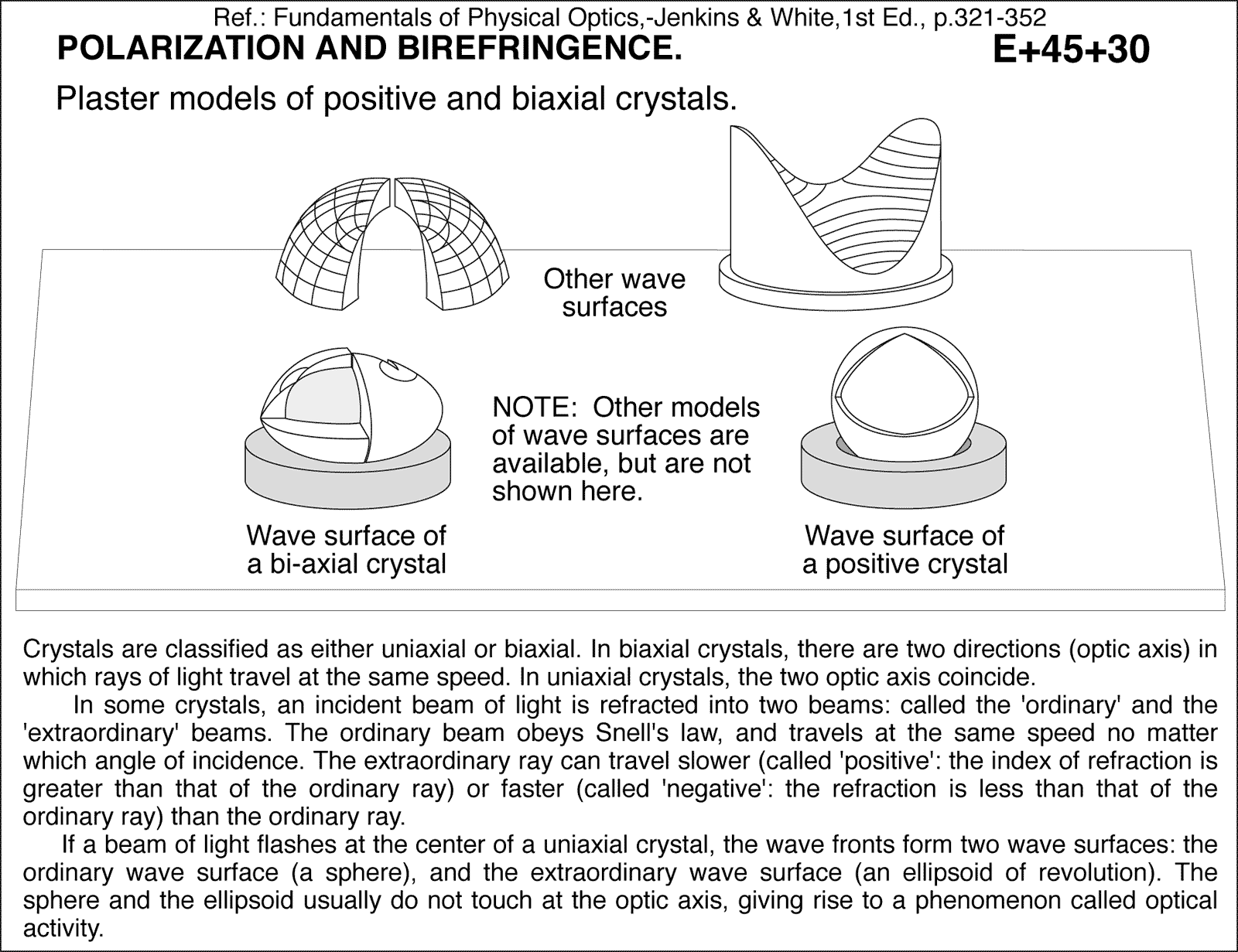
diagram for demo

Plaster models of positive and biaxial crystals. NOTE: Other models of wave surfaces are available, but are not shown here. Crystals are classified as either uniaxial or biaxial. In biaxial crystals, there are two directions (optic axis) in which rays of light travel at the same speed. In uniaxial crystals, the two optic axis coincide. In some crystals, an incident beam of light is refracted into two beams: called the 'ordinary' and the 'extraordinary' beams. The ordinary beam obeys Snell's law, and travels at the same speed no matter which angle of incidence. The extraordinary ray can travel slower (called 'positive': the index of refraction is greater than that of the ordinary ray) or faster (called 'negative': the refraction is less than that of the ordinary ray) than the ordinary ray. If a beam of light flashes at the center of a uniaxial crystal, the wave fronts form two wave surfaces: the ordinary wave surface (a sphere), and the extraordinary wave surface (an ellipsoid of revolution). The sphere and the ellipsoid usually do not touch at the optic axis, giving rise to a phenomenon called optical activity. Ref.: Fundamentals of Physical Optics,-Jenkins & White,1st Ed., p.321-352

Related Demos


E+45+61 Shiny object turns black viewed through linear polarizer and quarter wave plate E+45+0 Two picket fence sections with slats and rope to make waves. E+45+5 Microwaves with grid. Transmitter and receiver are polarized. E+45+10 Malus experiment: Polarization by reflection off glass surface. E+45+15 Polarization of light by internal reflection: Fresnel rhomb. E+45+20 Polarization of light through a pile of glass plates, using arc lamp. E+45+25 Commercial Polaroid filters on an OHP. E+45+35 Two tourmaline crystals act as polaroids, using arc lamp. E+45+40 Light through polaroid and calcite, using arc lamp. E+45+45 Model of a calcite crystal. E+45+50 Light through Nicol prism and Nicol analyzer, using arc lamp. E+45+55 Quartz prisms give a single and double spectrum, using arc lamp. E+45+60 Polarized light and stressed lucite on an OHP. E+45+65 Optical rotation of polarized light by sugar solution, using arc lamp. E+45+70 Optical rotation by sugar solution produces barber pole, using arc lamp. E+45+75 Mechanical model to show circular polarization; hand-cranked. E+45+80 Circular polarization with quarter wave plate, using arc lamp. E+45+85 Circular polarization of microwaves by elliptical metal tube. E+45+90 Circular polarization of microwaves: With reflector and grids. E+45+95 Polarized light thru Karo syrup shows dark bands, using arc lamp. E+45+100 10_ retarder plate makes dark bands in spectrum, using arc lamp. E+45+105 Sunset: solution in tank scatters blue light, using arc lamp. E+45+110 Visible nodes and antinodes in linearly birefringent plexiglass rod. E+45+115 Applet: Polarization of Light (3-D Version)