Sunset: solution in tank scatters blue light, using arc lamp.

6H50.10 • E+45+105
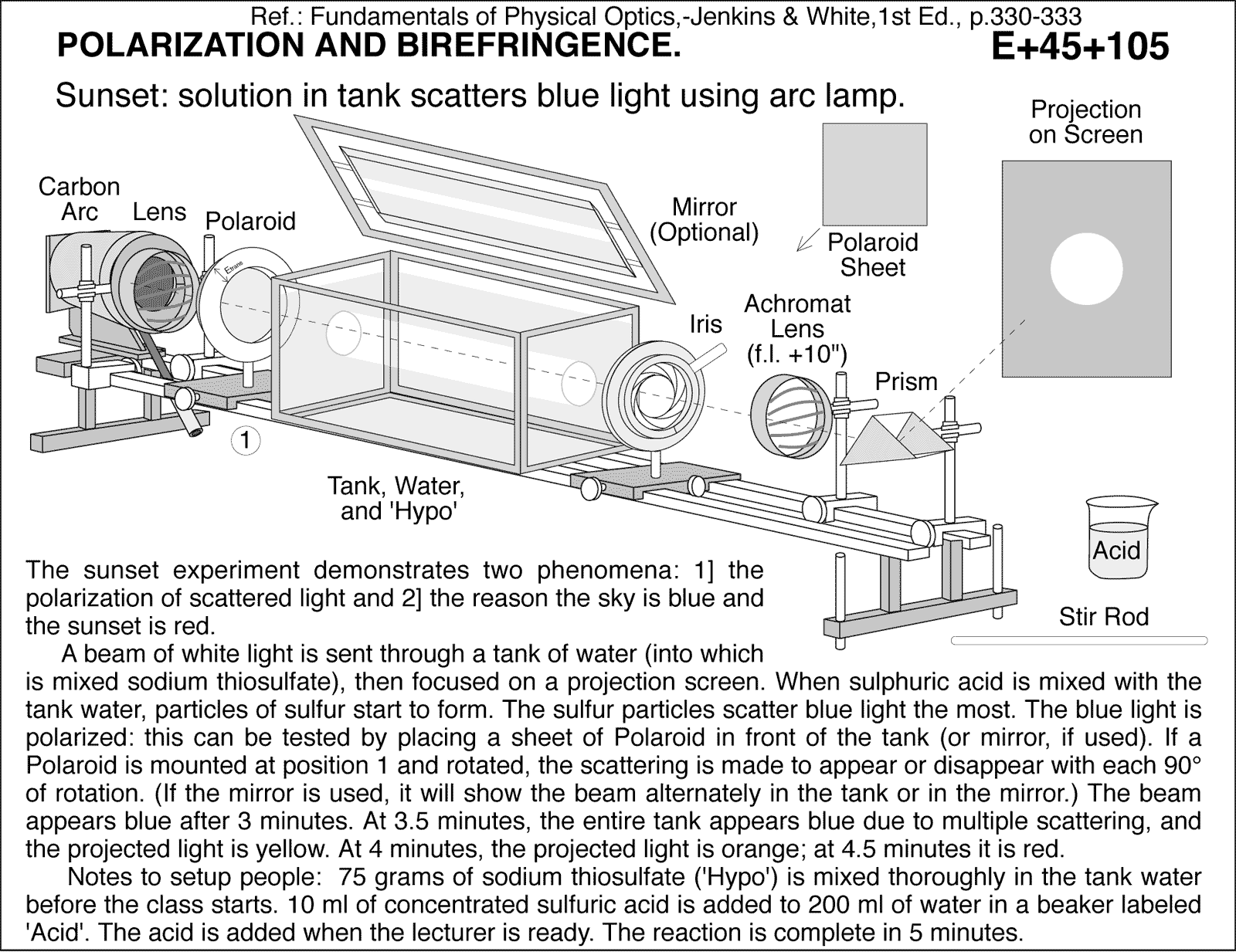
diagram for demo

Sunset: solution in tank scatters blue light using arc lamp. Ref.: Fundamentals of Physical Optics,-Jenkins & White,1st Ed., p.330-333 The sunset experiment demonstrates two phenomena: 1] the polarization of scattered light and 2] the reason the sky is blue and the sunset is red. A beam of white light is sent through a tank of water (into which is mixed sodium thiosulfate), then focused on a projection screen. When sulphuric acid is mixed with the tank water, particles of sulfur start to form. The sulfur particles scatter blue light the most. The blue light is polarized: this can be tested by placing a sheet of Polaroid in front of the tank (or mirror, if used). If a Polaroid is mounted at position 1 and rotated, the scattering is made to appear or disappear with each 90 deg of rotation. (If the mirror is used, it will show the beam alternately in the tank or in the mirror.) The beam appears blue after 3 minutes. At 3.5 minutes, the entire tank appears blue due to multiple scattering, and the projected light is yellow. At 4 minutes, the projected light is orange; at 4.5 minutes it is red. Notes to setup people: 75 grams of sodium thiosulfate ('Hypo') is mixed thoroughly in the tank water before the class starts. 10 ml of concentrated sulfuric acid is added to 200 ml of water in a beaker labeled 'Acid'. The acid is added when the lecturer is ready. The reaction is complete in 5 minutes. This is known as the Tyndall effect.

Related Demos


E+45+61 Shiny object turns black viewed through linear polarizer and quarter wave plate E+45+0 Two picket fence sections with slats and rope to make waves. E+45+5 Microwaves with grid. Transmitter and receiver are polarized. E+45+10 Malus experiment: Polarization by reflection off glass surface. E+45+15 Polarization of light by internal reflection: Fresnel rhomb. E+45+20 Polarization of light through a pile of glass plates, using arc lamp. E+45+25 Commercial Polaroid filters on an OHP. E+45+30 Plaster models of positive and biaxial crystals. E+45+35 Two tourmaline crystals act as polaroids, using arc lamp. E+45+40 Light through polaroid and calcite, using arc lamp. E+45+45 Model of a calcite crystal. E+45+50 Light through Nicol prism and Nicol analyzer, using arc lamp. E+45+55 Quartz prisms give a single and double spectrum, using arc lamp. E+45+60 Polarized light and stressed lucite on an OHP. E+45+65 Optical rotation of polarized light by sugar solution, using arc lamp. E+45+70 Optical rotation by sugar solution produces barber pole, using arc lamp. E+45+75 Mechanical model to show circular polarization; hand-cranked. E+45+80 Circular polarization with quarter wave plate, using arc lamp. E+45+85 Circular polarization of microwaves by elliptical metal tube. E+45+90 Circular polarization of microwaves: With reflector and grids. E+45+95 Polarized light thru Karo syrup shows dark bands, using arc lamp. E+45+100 10_ retarder plate makes dark bands in spectrum, using arc lamp. E+45+110 Visible nodes and antinodes in linearly birefringent plexiglass rod. E+45+115 Applet: Polarization of Light (3-D Version)