Circular polarization with quarter wave plate, using arc lamp.
6H35.40 • E+45+80
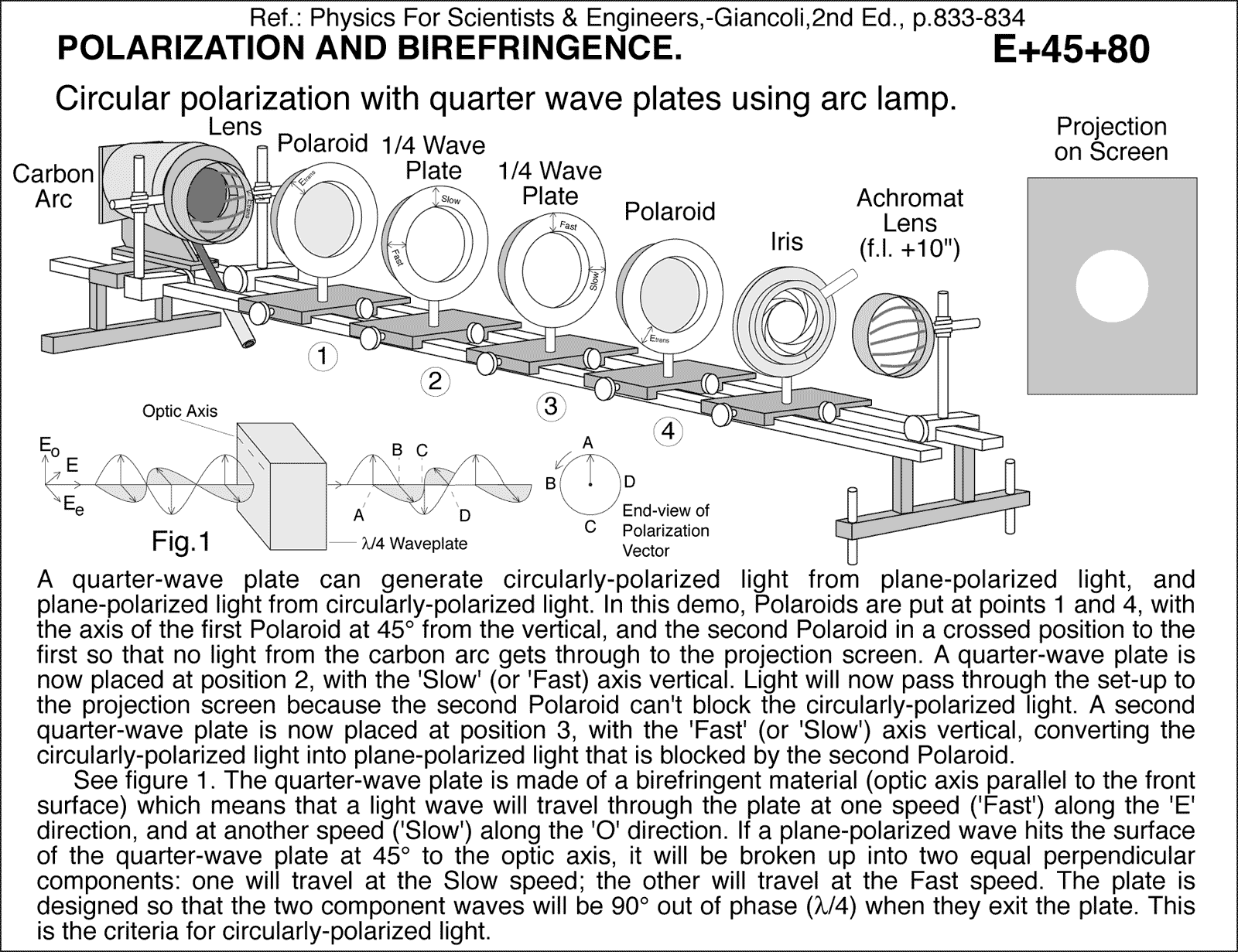
A quarter-wave plate can generate circularly-polarized light from plane-polarized light, and plane-polarized light from circularly-polarized light. In this demo, Polaroids are put at points 1 and 4, with the axis of the first Polaroid at 45 deg from the vertical, and the second Polaroid in a crossed position to the first so that no light from the carbon arc gets through to the projection screen. A quarter-wave plate is now placed at position 2, with the 'Slow' (or 'Fast) axis vertical. Light will now pass through the set-up to the projection screen because the second Polaroid can't block the circularly-polarized light. A second quarter-wave plate is now placed at position 3, with the 'Fast' (or 'Slow') axis vertical, converting the circularly-polarized light into plane-polarized light that is blocked by the second Polaroid. See figure 1. The quarter-wave plate is made of a birefringent material (optic axis parallel to the front surface) which means that a light wave will travel through the plate at one speed ('Fast') along the 'E' direction, and at another speed ('Slow') along the 'O' direction. If a plane-polarized wave hits the surface of the quarter-wave plate at 45 deg to the optic axis, it will be broken up into two equal perpendicular components: one will travel at the Slow speed; the other will travel at the Fast speed. The plate is designed so that the two component waves will be 90 deg out of phase (_/4) when they exit the plate. This is the criteria for circularly-polarized light. Circular polarization with quarter wave plates using arc lamp. Ref.: Physics For Scientists & Engineers,-Giancoli,2nd Ed., p.833-834
No recorded usage yet
This demo hasn't been reserved yet.